รายการของคุณว่างเปล่า
เพิ่มสินค้าเพื่อขอใบเสนอราคา

Every time a cell in your body dies, it leaves DNA fragments behind in blood, mucus, or tissue fluid. Left alone, that debris doesn't just sit there. The immune system reads loose DNA as a danger signal, a category scientists group under DAMPs, and reacts accordingly.
This free-floating DNA, often called exDNA, builds up in conditions from cystic fibrosis to autoimmune disease and severe trauma, which is why clearing it out becomes important, in the body and in a test tube.
That clearing job belongs to a family of enzymes called DNase. In medicine, it breaks down the extracellular DNA clogging an inflamed airway. On a lab bench, the same enzyme encounters a more specific challenge.
Stray genomic DNA sneaks into RNA preparations and quietly wrecks RT-PCR results, which is exactly why RNase-free DNase I has become close to standard for anyone doing serious RNA work and why the difference between DNase I and DNase II is worth knowing before you reach for either one.
DNase is a nuclease, an enzyme that catalyzes the breakdown of DNA by cutting the phosphodiester bonds connecting one nucleotide to the next. The reaction itself is hydrolysis. DNase uses a water molecule to snap each bond, leaving behind shorter DNA fragments or, given enough time, individual nucleotides.
DNase isn't confined to a single organ or a single set of conditions. It shows up all over the body, and its two major forms are tuned to work in very different chemical environments.
How DNase Works
DNase enzymes are hydrolases that target the sugar-phosphate backbone of DNA, not any particular sequence, so they cleave indiscriminately when they encounter a target strand. Two variables determine how well a given DNase performs:
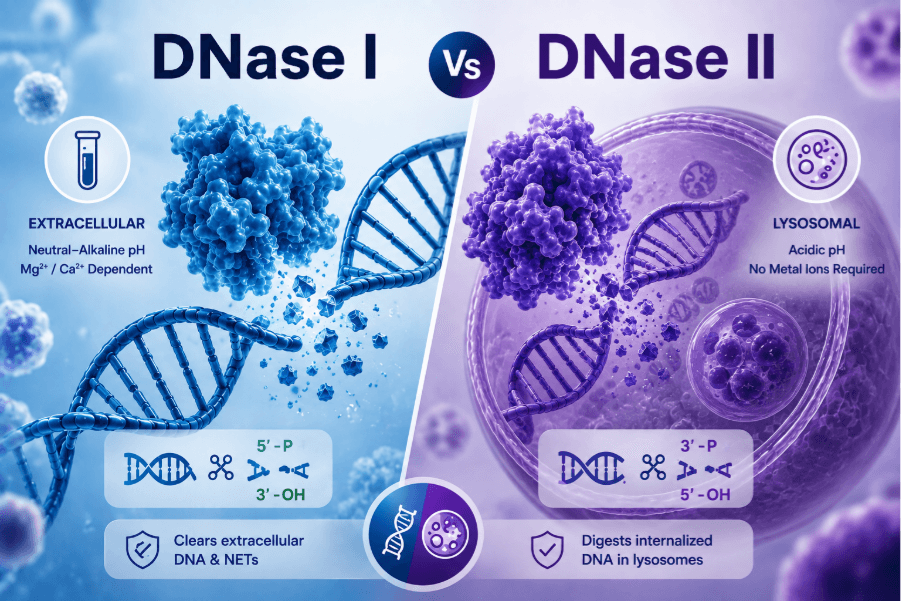
Despite sharing a name, DNase I and DNase II work almost like two separate tools designed for two different jobs.
DNase I enzyme activity is what most labs mean when they just say DNase, no qualifier needed.
DNase II operates almost entirely inside cells, specifically inside lysosomes, the acidic compartments where cells break down whatever they've engulfed.
DNase research has one clear, FDA-approved payoff in medicine so far and one area where the evidence just hasn't followed.
The clearest real-world payoff of DNase research is dornase alfa, sold under the brand name Pulmozyme, a recombinant version of human DNase I that the FDA approved back in 1993 for cystic fibrosis.
Given how well it worked for cystic fibrosis, researchers reasonably asked whether the same enzyme could help other lung conditions built around excess mucus.
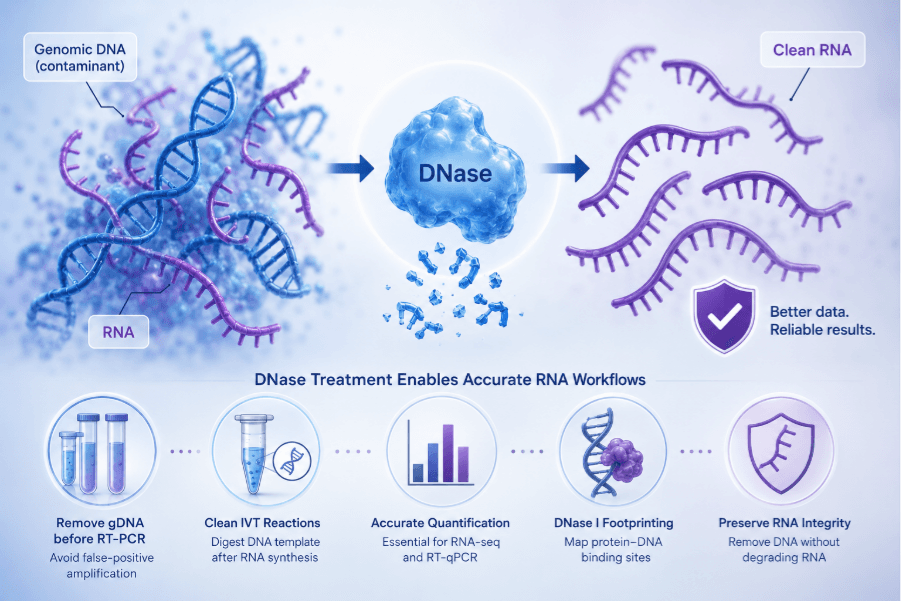
DNase in RNA extraction shows up in nearly every standard workflow, whether it's column-based or a classic phenol-chloroform prep, since RNA and DNA are chemically similar enough that a clean separation is genuinely difficult to pull off. That leftover genomic DNA causes real problems downstream.
An RNA-seq study published in BMC Genomics measured this effect directly. Even after standard DNase digestion, roughly 1.8 percent residual genomic DNA remained in the tested samples, a small number that was enough to distort results in a big way:
The same contamination problem shows up in RT-PCR, where primers spanning an intronless region or a pseudogene can amplify genomic DNA right alongside the intended cDNA target, producing a signal that looks like a real positive but isn't.
Here's a catch that trips up a surprising number of labs. Using DNase to protect RNA only works if the DNase preparation itself is free of ribonuclease activity. Standard DNase I, especially older bovine pancreatic preparations, can carry trace RNase contamination left over from purification, since both enzymes occur naturally in pancreatic tissue. Add a DNase like that to an RNA sample meant for RT-PCR or RNA-seq, and it can quietly degrade the very RNA the digestion step was supposed to protect.
RNase-free DNase I is manufactured and quality-tested to confirm no detectable RNase activity survives in the final product. That certification is exactly why protocols for RNA cleanup, cDNA synthesis, and RNA-seq library prep call out RNase-free grade by name, and it's a baseline requirement for anyone routinely working with molecular biology reagents in an RNA lab.
DNase does one job well, cutting DNA apart, but where and how it does that job varies a lot, from clearing DAMPs out of inflamed tissue to protecting a delicate RNA-seq library from a few stray nanograms of genomic DNA.
XL Biotec supplies RNase-free DNase I, supplied at 2,000 units per vial and manufactured as RNase-free, alongside the wider molecular biology reagents range for RNA and DNA prep. Buy DNase I RNase-free directly through the product page, or request a quote for bulk pricing or shipping details.
1. What is DNase and how does it work?
DNase is an enzyme that cleaves the phosphodiester bonds in the DNA backbone, breaking long DNA strands into shorter fragments or single nucleotides. It does not recognize a specific sequence, so it will cleave any DNA it encounters, provided the pH and cofactors are appropriate.
2. What is the difference between DNase I and DNase II?
DNase I works at neutral to alkaline pH, needs magnesium or calcium ions, and operates mainly outside cells, including in RNA extraction. DNase II works in the acidic environment of lysosomes, needs no metal cofactors, and mainly digests DNA that cells have engulfed internally.
3. Why is DNase treatment necessary during RNA extraction?
Every standard extraction method drags along trace genomic DNA. That leftover DNA can cause false-positive signals in RT-PCR and skew gene expression counts in RNA-seq, so DNase treatment clears it out before those steps run.
4. What is RNase-free DNase and when should it be used?
It's a DNase I preparation manufactured and tested to confirm no detectable ribonuclease activity. Use it any time DNase is applied to an RNA sample, since trace RNase contamination can degrade the RNA it was meant to protect.
5. How do you perform on-column vs in-solution DNase treatment?
On-column treatment applies DNase to RNA while it's still bound to a silica membrane mid-extraction, which is fast and limits handling. In-solution treatment applies DNase after elution, generally clearing gDNA more completely but requiring an extra cleanup step.
6. How do you properly inactivate DNase after treatment?
Heat denaturation around 75°C stops digestion cleanly. So does adding EDTA, which chelates the magnesium and calcium ions the enzyme needs to function. Either method keeps residual DNase activity from interfering with reverse transcription.
7. How can I verify DNA contamination was removed after DNase treatment?
Run a no-reverse-transcriptase (minus-RT) control alongside your qPCR; amplification there points to leftover genomic DNA. Primers spanning an intron-exon junction add another layer of confidence, since they only amplify efficiently from cDNA.
8. Can DNase be used directly in live cell culture experiments?
DNase I is sometimes added to culture media or dissociation solutions to cut down on clumping caused by DNA from dead or damaged cells, but it doesn't act on DNA inside intact living cells, since it can't cross an undamaged plasma membrane.
9. What concentration of DNase is recommended for RNA cleanup?
A common starting point is 1 unit of DNase I per microgram of RNA, incubated at 37°C for 15 to 30 minutes, adjusted for the specific sample type and RNA yield.
10. What is the difference between DNase and RNase, and when do you need each?
DNase degrades DNA and RNase degrades RNA. DNase is applied during RNA extraction to remove contaminating genomic DNA, while RNase is applied during plasmid or genomic DNA preps to clear out contaminating cellular RNA.
