Your list is empty
Add products to request a quote

Key Takeaways:
Extracellular Deoxyribonucleic Acid (exDNA) functions as a danger-associated molecular pattern (DAMP), often released by dead cells through natural metabolic processes.
Significant exDNA production can trigger various immune system responses. Immune sensors instantly recognize the molecule, causing a series of autoimmune reactions like inflammation.
Although extracellular DNA promotes cell survival and biofilm stability, it can prove harmful if allowed to linger in the bloodstream. That’s where DNase comes in.
DNase plays a critical role in the body’s natural waste management, clearing exDNA from your system. This essential biological process prevents the body from turning on its DNA and triggering unintended autoimmune reactions.
DNase comes in two families, with DNase I enzyme being more preferable for its higher adaptability. This guide explores DNase and the critical role it plays in RNA-based experiments.
Table of Contents
DNase stands for Deoxyribunuclease, a natural enzyme that catalyzes DNA degradation by breaking up its chemical nucleotide bonds.
While DNase may sound destructive, it plays a fundamental role in cleansing your system of toxic extracellular DNA from dead cells and immune traps. Allowing these molecules to accumulate in the body can trigger acute autoimmune responses, including inflammation and hypersensitivities.
DNase clears potentially harmful genetic materials before they can build up to toxic levels. The enzyme has become a staple in RNA-based experiments, improving accuracy in complex genetic tests like RNA sequencing (RNA-seq).
DNase I enzyme, a subfamily of DNase, has demonstrated a greater promise at preventing false positives in RNA-based experiments. The molecule is free from degrading RNases, reducing contamination threats in molecular experiments.
As it’s a natural enzyme, DNase exists throughout the body. Common locations include;
To function effectively, DNase requires two biological processes - hydrolysis and digestion.
First, the enzyme chemically breaks down DNA nucleotide bonds by activating a nucleophilic attack on the bonds located between phosphate groups and sugars.
Further degradation occurs when DNase is exposed to specific pH and metal ion conditions.
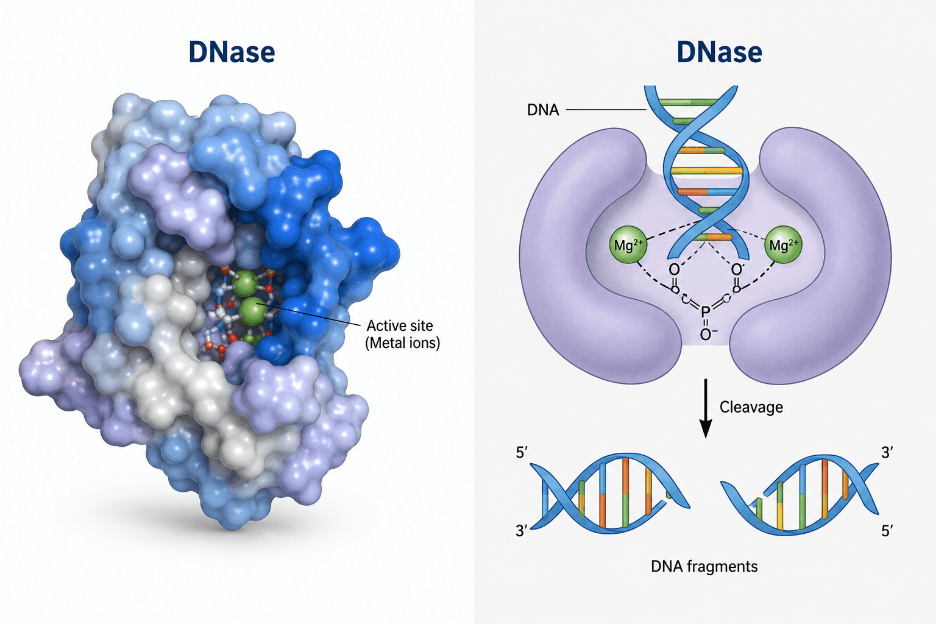
The earliest recorded evidence of enzymatic DNA breakdown goes back to 1903, when Japanese researcher K. Araki observed that certain enzymes could degrade the nucleic acid. While Araki erroneously inferred these effects as proteolytic, his discovery set the stage for subsequent genetic studies.
In 1905, H. Sachs proved that the most bioactive agent responsible for liquefying nucleate gels was distinct from common enzymes. Numerous researchers assigned the molecule varied names over the years.
In 1950, Moses Kunitz of the Rockefeller Institute created the purest form of DNase I. The DNase Footprinting assay was eventually developed in 1978, revolutionizing how researchers studied the relationship between proteins and DNA.
1993 became another watershed moment in DNase development, after the U.S. Food and Drug Administration (FDA) approved recombinant human DNase I called dornase alfa. Sold under the brand name Pulmozyme, dornase alfa is one of the most effective cystic fibrosis treatments.
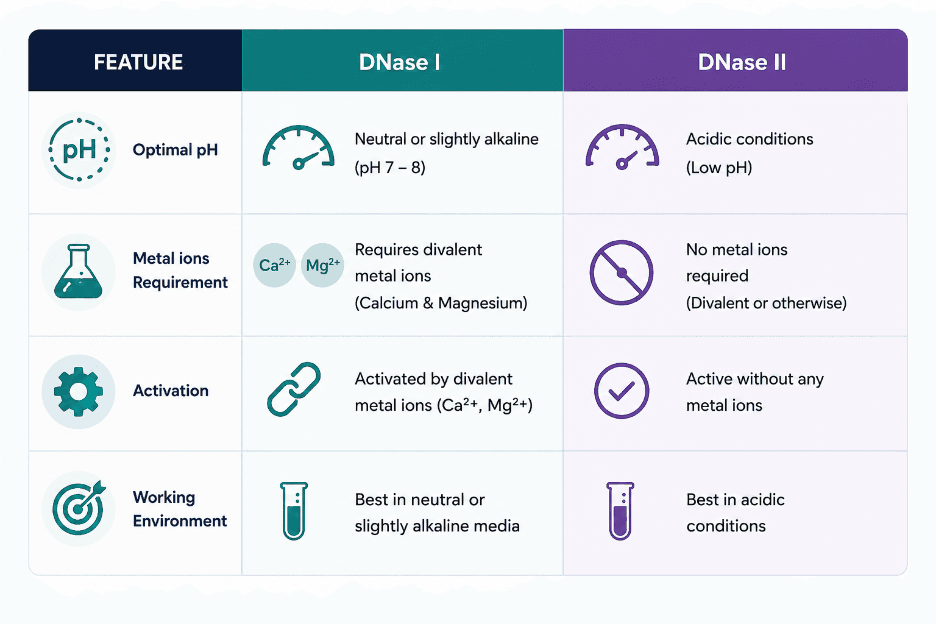
DNase falls into two distinct families, which differ fundamentally in their optimal working environments.
This DNase subset works best in neutral or slightly alkaline media, with an average pH range of 7 - 8. It also activates when exposed to divalent metal ions like calcium and magnesium.
DNase II performs optimally under acidic conditions. When working with this enzyme, you won’t require metal ions (divalent or otherwise) to kick-start a catalytic process.
DNase is widely utilized in managing Cystic Fibrosis.
CF occurs when a gene called Cystic Fibrosis Transmembrane Conductance Regulator causes the body to produce excessively thick and dehydrated mucus. As this mucus is extremely viscous, it can trap and kill immune cells called neutrophils.
The dying neutrophils break down and release extracellular DNA into the airways, causing more harmful DNA-rich mucus.
Studies have shown that recombinant human DNase, such as Pulmozyme, can ease Cystic Fibrosis by catalyzing the breakdown of extracellular DNA in airway mucus.
During chronic inflammation, the body produces an enormous number of white blood cells. These natural defense cells fight infections by releasing Neutrophil Extracellular Traps (NETs).
Although NETs may alleviate inflammation in the short run, excess amounts can thicken mucus and lead to chronic tissue damage.
DNase dissolves NETs and clears them from your airways before they can cause severe tissue damage. The enzyme has demonstrated a remarkable promise at easing inflammation associated with COPD, asthma, and similar respiratory illnesses.
While conducting RNA sequencing in the laboratory, researchers often use short primers that might not effectively distinguish between DNA and RNA. These primers can convert genomic DNA into complementary DNA (cDNA).
Unchecked conversion of DNA into cDNA complicates an otherwise straightforward transcript expression by introducing a totally needless step. Besides, it can lead to genetic waste that diminishes the authenticity of the sequencing process.
Using DNase degrades the contaminating gDNA and ensures subsequent analyses only factor in RNA. It’s the most reliable way to guarantee RNA purity and credibility.
Reverse Transcription-PCR (RT-PCR) is a high-precision experiment that requires pure DNA materials.
Often, it only takes traces of complementary DNA to falsify the outcome. Any present genetic junk can serve as a template in RT-PCR and amplify residual gDNA, compromising your experiment’s integrity.
DNase not only removes DNA contamination but also RNA. It also digests cDNA more readily, so you can focus exclusively on RNA targets.
This reduces background signals that could result in false positives, maximizing the experiment’s data reliability.
DNA and RNA absorb ultraviolet (UV) light at similar wavelengths - 260 nm. So, if an RNA extract contains significant amounts of genomic DNA, the molecule can contaminate your sample and artificially inflate the fluorometer or spectrophotometer readings.
The result? Over-quantification of RNA yield.
By degrading contaminating DNA, DNase fosters more accurate RNA quantification.
RNase-free DNase is particularly effective at eliminating background noise during RNA-based experiments. The enzyme chops single-stranded and double-stranded DNA into fragments of mononucleotides and oligonucleotides, rendering the remaining 260 nm absorbance nearly 100% RNA-specific.
A DNA template is essential during in vitro transcription (IVT). However, the template is reduced into contaminating junk once the reaction is done.
Adding DNase helps break down the residual DNA template without interfering with the newly synthesized RNA. Thus, subsequent reactions only factor in RNA, reducing template signal interference.
Because of its ability to digest DNA templates while leaving RNA intact, DNase has become a staple in downstream reactions that require pure RNA, such as;
Reverse transcription entails synthesizing complementary DNA from RNA templates. The process, aided by the reverse transcriptase enzyme, enables researchers to convert unstable RNA into the more stable DNA for effective analysis.
Note that certain DNase inactivation processes require heat that exposes DNA strands to temperatures around 65OC for about 10 minutes.
Besides stopping DNase activity, these extreme conditions also denature RNA secondary structures. The reverse transcriptase enzyme can then access and attach to the RNA more effectively, reducing quantification errors.

DNase I, the most useful in RNA-based experiments, functions as a molecular scalpel in the DNase I Footprinting assay.
First, DNase cleaves off the strands in naked DNA, sometimes at every nucleotide. This creates a stream of differently sized, fluorescently or radioactively labeled fragments.
The DNase digestion enzyme is also involved in steric hindrance.
When DNA-binding proteins attach to DNA, their bulky structures prevent DNase from accessing and breaking down their phosphodiester bonds. This temporary inhibition is what underpins DNase I Footprinting. It enables scientists to pinpoint the specific sites for DNA-binding proteins for targeted action.
DNA and RNA are genetically similar. Therefore, enzymes that break down one molecule can inadvertently denature the other.
Interestingly, DNase digests DNA while preserving the fragile RNA material. Researchers can accurately measure RNA in samples without accounting for unnecessary background noise.
As noted, you can improve the DNase protocol in molecular biology by utilizing RNase-free DNase I. This guarantees that your sample contains no RNases that might break down the target RNA and falsify the outcome.
Check out validated /products-dnase-i-rnase-free and optimize the integrity of your RNA-based experiments.
Success in molecular biology experiments depends on sample purity. Rather than settle for standard DNase, which may be highly contaminated with enzyme-destroying RNases, insist on RNase-free DNase 1 enzyme.
DNase I contains no degrading RNases. As such, you can use it effectively to eliminate genomic DNA without contaminating your set-up. The enzyme is notably effective when used before sensitive downstream applications, such as RNA sequencing and RT-PCR.
Because DNase plays a critical part in eliminating potentially harmful exDNA, you want the purest form of the molecule you can find.
XL Biotec supplies industry-validated RNase-free DNase I designed to degrade single- and double-stranded DNA. We facilitate rapid logistics, ensuring your research program doesn’t stall.
Whether you’re conducting basic RNA sequencing or more advanced procedures like RT-PCR, you can trust XL Biotec’s DNase I enzyme to deliver.
Contact us today to order professionally formulated DNase I and safeguard the credibility of your next RNA-based molecular experiment.
DNase is an enzyme that breaks down DNA's chemical nucleotide bonds, catalyzing its degradation.
DNase I works optimally under neutral pH and in the presence of divalent cations, while DNase II performs best in acidic environments and independent of cations.
DNA and RNA are often released simultaneously during cell lysis. Besides, the molecules may be co-purified since they're both nucleic acids.
DNase treatment breaks down RNA and contaminating genomic DNA, preventing it from being falsely detected during downstream RNA experiments.
To perform an on-column DNase treatment, apply sample lysate to a spin column. Let the RNA attach to the filter, and then add DNase to the column to break down the DNA bonds.
For in-solution treatment, mix DNase with RNA and incubate in a reaction buffer in a test tube. You can then purify the RNA after the experiment to eliminate the buffer.
RNase-free DNase contains no contaminating RNase, preventing RNA degradation during DNA digestion.
DNase inactivation usually requires exposing a sample to 65 °C for around 10 minutes.
Since heating RNA in the presence of cations can degrade the molecule, you might consider alternative heatless methods like spin columns and EDTA chelation.
To verify complete elimination of contaminated DNA in DNase treatment, perform a no-Reverse Transcriptase control experiment during a downstream QPCR or PCR. Evidence of an amplification product suggests some DNA is still present.
Not recommended. DNase is an extracellular enzyme and doesn’t readily pass through the plasma membranes of live cells.
That said, you can use the enzyme to digest genomic DNA around live cell cultures to prevent them from clogging up the media.
For effective RNA cleanup, start with 1-2 units of DNase per microgram of RNA and incubate the sample for 15-30 minutes at 37 °C. Screen and add more DNase incrementally if necessary.
DNase digests DNA, while RNase digests RNA. You require DNase to extract pure RNA from samples containing genomic DNA materials, and RNase to obtain DNA by removing contaminating RNA.
