Your list is empty
Add products to request a quote

If you work in cell biology, immunology, or oncology research, you may have seen RPMI 1640 on a reagent shelf or in a protocol. There are good reasons this is one of the most popular types of cell culture media worldwide. Since its establishment at Roswell Park Memorial Institute in the 1960s, it has supported decades of groundbreaking research, from drug testing to vaccine development to cancer biology.
But just knowing the name of a medium is not the same as really knowing how to use it. This guide tells you everything you need to know about RPMI 1640, such as what it’s made of, how to use it, how to prepare it correctly, and how it compares to other common media. This is how you can get the most out of each culture.
What Is RPMI 1640?
The name **RPMI 1640** is an abbreviation of Roswell Park Memorial Institute 1640. It’s the name of the cancer research center in Buffalo, New York, where its creator, scientist George E. Moore, and his colleagues developed it in 1966.
The medium was specifically designed to allow human leukemic cells to grow in suspension, unlike previous media designed for adherent cells. What differentiated it was the bicarbonate-buffering mechanism and a well-balanced amino acid and vitamin composition.
These properties rendered it applicable not only to leukemic cells but also to a broad spectrum of mammalian cell types. The formula hasn’t really changed since, a fact in itself that shows just how well it was initially designed.
Today, RPMI 1640 for cell culture is the foundation of research in immunology, oncology, virology, and drug development.
RPMI 1640 Composition: What’s Inside the Formula?
When researchers understand **RPMI 1640 composition**, they can make informed decisions about supplements, address growth problems, and adjust the medium for specific uses. The base formula contains several carefully balanced component categories.
RPMI 1640 contains 20 amino acids. Glutamine is present at 300 mg/L as a primary energy source for rapidly dividing cells, alongside arginine, asparagine, leucine, lysine, tryptophan, and other amino acids.
There are a lot more vitamins in this than in many older formulas. It has vitamin B12, thiamine, riboflavin, niacinamide, PABA, folic acid, and biotin. RPMI 1640 differs from DMEM because it contains inositol and PABA, which support the growth of lymphoid cells.
Calcium nitrate, magnesium sulfate, potassium chloride, sodium bicarbonate, sodium chloride, and sodium phosphate dibasic help with osmolarity and membrane potential. This formula differs because it uses calcium nitrate rather than calcium chloride.
The primary energy source is 2.0 g/L of glucose. This is lower than DMEM’s high-glucose formulation, making it better suited for most immune cell applications.
The formula contains glutathione, a reducing agent that supports the body’s antioxidant defenses; phenol red, which indicates pH; and sodium bicarbonate, which helps maintain balance. The standard pH level should be between 7.2 and 7.4.
What Is RPMI 1640 Used For?
One of the most common questions in cell biology labs is, “ What is RPMI 1640 used for?“ For almost 60 years, the medium has been a standard in labs because it works with many cell types and across many research settings.
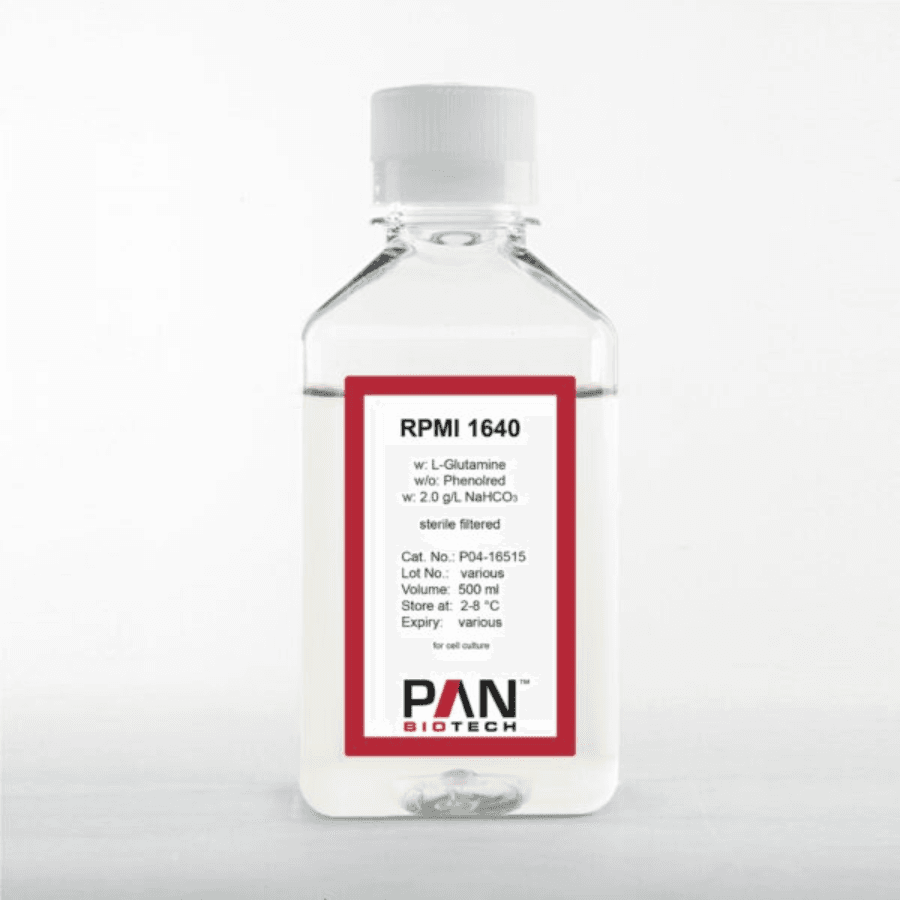
RPMI 1640 vs. Other Cell Culture Media
To choose the appropriate medium, you must know how various formulations work. The table below compares RPMI 1640 against the three most commonly used alternative media.
| | | | | |
| Developed for | Suspension/leukemic cells | Adherent cells | Adherent cells | Modified suspension culture |
| Glucose (g/L) | 2.0 | 1.0 or 4.5 | 1.0 | 4.5 |
| Vitamin richness | High (11 vitamins) | Moderate | Low | High |
| Buffering system | Sodium bicarbonate | Sodium bicarbonate | Sodium bicarbonate | Sodium bicarbonate + HEPES option |
| Best suited for | Lymphocytes, leukemia lines, PBMCs | Fibroblasts, epithelial cells | Primary cells, diploid fibroblasts | Rapidly dividing cells, hybridomas |
| Serum requirement | Typically, 10% FBS | Typically 10% FBS | Typically 10% FBS | Typically 10% FBS |
RPMI 1640 works better than DMEM and MEM for suspension cultures and immune cell applications. IMDM competes most closely with RPMI 1640 for hybridoma work. Still, RPMI 1640 is the most appropriate choice for immunological studies due to its long history of use with primary immune cells.
How to Prepare RPMI 1640 Medium
To make RPMI 1640 medium correctly, you need to monitor water quality, sterility, supplements, and pH at each step.
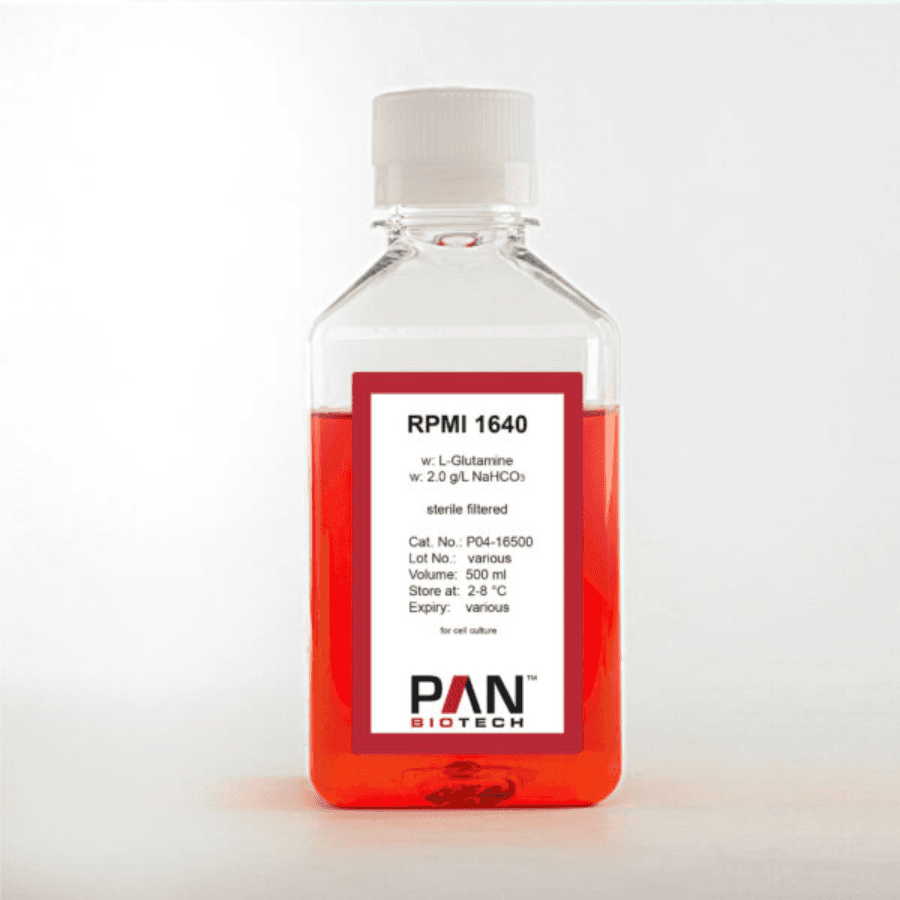
Supplies required include a base of RPMI 1640 in powder or liquid, ultrapure water free of endotoxins, sodium bicarbonate, L-glutamine or GlutaMAX, FBS (10 per cent v/v), a 0.22 um sterile filter, a pH meter, and a biosafety cabinet.
Tips and Common Mistakes
Tips
Avoid these Common Errors
Final Thoughts
In modern cell biology, RPMI 1640 is one of the most reliable media formulations. This isn’t because of advertising; it’s because it has been used in thousands of labs around the world for almost 60 years and consistently yields the same results.
Its rich vitamin profile, physiologically appropriate glucose concentration, and proven compatibility with immune and hematopoietic cell types make it genuinely difficult to replace for the applications it was built to serve.
That said, no medium works well on its own. How well your cultures grow or fail depends on the quality of your water, how well you prepare it, how fresh your glutamine is, and how consistently you stick to your supplementation plan. If you want reliable results rather than frustratingly inconsistent ones, you need to understand the composition and preparation of RPMI 1640 more deeply than just following the steps.
The best way to set up your experiment is to start with the right RPMI 1640 for cell culture. This will help you keep an established leukemia cell line, run a primary PBMC assay, or make more hybridomas. Get the basics right, and the medium will do its job.
Frequently Asked Questions on RPMI 1640
Yes, many adherent lines perform well in RPMI 1640 containing 10% FBS. But DMEM or MEM are more appropriate for adherent cell types.
Yes, the buffering system with sodium bicarbonate requires a 5% CO₂ atmosphere to maintain a pH of 7.2-7.4. Add 10-25 mM HEPES in case you wish to regulate the pH yourself.
The most common additions are 10% FBS, 2 mM L-glutamine or GlutaMAX, and 1% penicillin-streptomycin, with optional sodium pyruvate or beta-mercaptoethanol depending on the application.
Yellow medium signals a pH drop below 7.0, most commonly caused by excess CO₂, overly dense cultures, contamination, or medium that was not equilibrated before use.
