Your list is empty
Add products to request a quote

Identification of biological molecules is a fundamental requirement in advanced healthcare and in research on diseases and biotechnologies. Proteins, antibodies, cytokines, hormones, and other proteins are considered biomarkers, and laboratories require accurate data to detect them using reliable and specific tests. Among these methods, ELISA is one of the most popular immunoassay technologies used to allow sensitive and quantitative analysis of biological targets.
Studies highlight that ELISA is widely used in laboratories to accurately, reliably, and sensitively quantify peptide and protein molecules in biological samples, making it an essential tool for research, diagnostics, and biotechnology applications.
Nowadays, ELISA is used for biomarker discovery, disease research, vaccine development, and pharmaceutical studies in various research facilities, biotechnology firms, and diagnostic laboratories. To support these applications, XL Biotec provides high-quality ELISA kits, antibodies, recombinant proteins, cytokines, and research reagents to help scientists achieve consistent and reliable results.
Keep reading to understand ELISA kit types, principles, applications, and their growing role in modern healthcare.
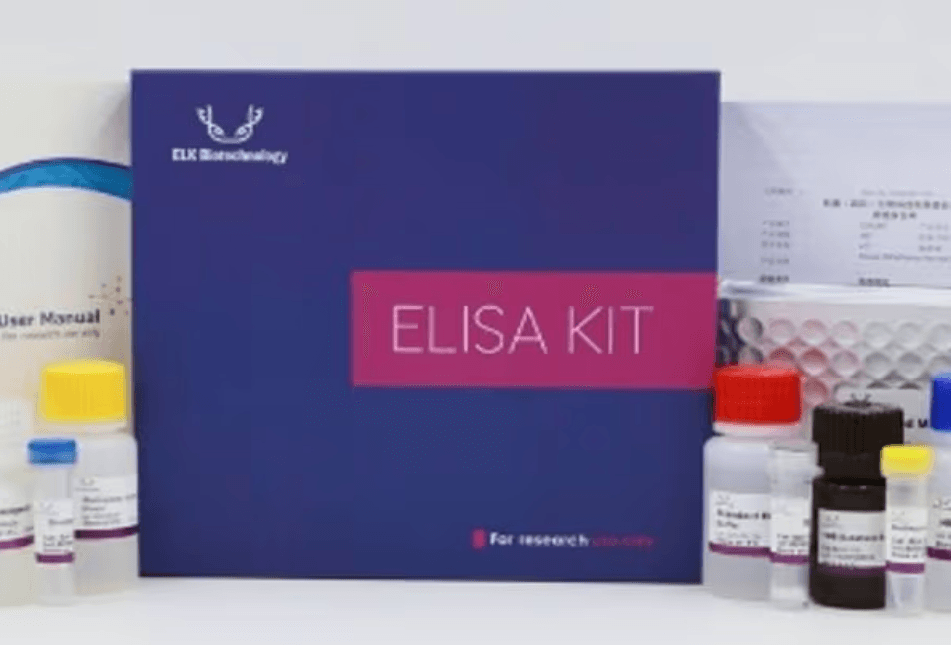
An ELISA kit (enzyme-linked immunosorbent assay) is a laboratory tool used to measure, detect, and quantitate specific biological molecules by utilizing antigen-antibody interactions. The principle is based on the affinity and specificity of antibodies that enable the identification of targeted molecules in complex samples.
An ELISA test can detect various biological substances, including:
The basic concept behind an ELISA assay involves attaching an antigen or antibody to a microplate surface. Following this, the introduction of a biological sample results in each molecule being bound by a specific antibody. As a result, this produces a measurable change, typically in color, using an enzyme-linked detection system. The strength of this signal is proportional to the level of target molecule concentration.
ELISA kits are widely used in:
For researchers selecting an ELISA kit for research, factors such as assay sensitivity, detection range, validation data, and sample compatibility are important for achieving reliable results.
Explore XL Biotec’s life science research solutions, including ELISA kits, antibodies, recombinant proteins, cytokines, and molecular biology reagents.

Each investigational project will have its own preferred format of the assays. Therefore, the four main types of ELISA include direct ELISA, indirect ELISA, sandwich ELISA, and competitive ELISA. The methods differ in their detection techniques as a function of the molecule and the level of sensitivity needed.
Direct ELISA uses an enzyme-labeled primary antibody that directly binds to the target antigen. In this method, the labeled antibody enables the detection of the antigen through an enzyme-based signal.
Advantages:
Applications:
However, the direct ELISA format usually does not lead to high levels of signal amplification.
In indirect ELISA, there are two antibodies. In this process, a primary antibody recognizes and binds to the targeted antigen, and a secondary antibody, coupled with an enzyme, identifies the primary antibody.
Advantages:
Applications:
This technique is frequently utilized when there is a need to quantify the antibody level in biological samples.
Sandwich ELISA is a useful assay for the quantitative measurement of protein due to its high specificity and sensitivity.
This method uses two antibodies:
Because the antigen is detected between two antibodies, this format is called “sandwich” ELISA.
Advantages:
Applications:
Competitive ELISA is a method in which the labeled molecules can compete with the target molecule for the antibody binding site. In this process, the signal decreases as the amount of target analyte increases.
Advantages:
Applications:
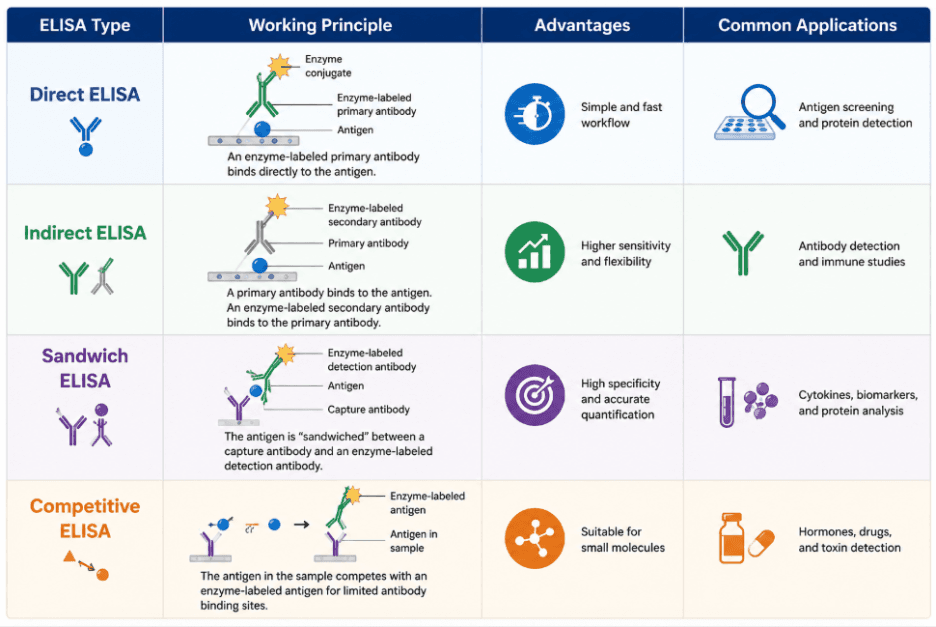
The ELISA principle is based on the immobilization of antigen-antibody interactions of very high specificity. Through this process, this binding ability enables researchers to find the target molecules even in complex biological samples.
A typical ELISA procedure includes the following steps:
Depending on the type of the assay, an antigen or antibody is coated on a microplate well.
The samples, which include biological materials like serum, plasma, tissue extracts, or cell culture products, are placed in the plate.
The antibody will specifically bind to the targeted molecule.
The molecules are first removed during this step to reduce background signals and enhance accuracy.
An enzyme is linked to an antibody that binds to a substrate to generate a measurable signal.
The intensity of the signal is read by a microplate reader, which enables the researcher to determine the quantity of target molecule present.
A standard ELISA kit usually contains:
Following the recommended ELISA test procedure and using validated reagents helps laboratories maintain consistent and reproducible results.

ELISA technology continues to be used widely as the healthcare and science marketplace advances the fields of earlier detection, precision medicine, and biomarker-based approaches.
One of the most important uses of ELISA is identifying disease-related markers and immune responses.
ELISA supports:
The ability to detect specific biological markers makes ELISA valuable in understanding disease progression and evaluating treatment responses.
Researchers and pharmaceutical companies use ELISA kits throughout drug discovery and development.
Applications include:
Biologics and personalized medicine are on the upswing, and as a result, accurate detection methods of these biomarkers are taking on increased significance.
ELISA technology is also used beyond healthcare.
Food laboratories use ELISA for detecting:
Veterinary researchers use ELISA for:
These applications demonstrate the versatility of ELISA across different scientific fields.
Several factors contribute to the growing adoption of ELISA technology:
Scientists continue to discover new biomarkers associated with diseases, creating demand for reliable detection methods.
Expanding fields such as:
require accurate protein and antibody analysis.
Laboratories require validated assays that provide consistent results across experiments. Selecting reliable suppliers with technical expertise helps researchers improve workflow efficiency.
XL Biotec supports research organizations with access to ELISA kits and related life science products designed for academic, biotechnology, and pharmaceutical applications.
ELISA kits are crucial for healthcare and life science research, where proteins, antibodies, biomarkers, and other biological molecules require specific identification. Additionally, the wide range of scientific applications in which ELISA technology is used includes disease research, biomarker discovery, pharmaceutical development, and food safety testing.
Choosing the right ELISA solution requires evaluating factors such as sensitivity, specificity, validation, and sample compatibility. XL Biotec provides high-quality ELISA kits and research reagents to help laboratories achieve reliable results.
Explore XL Biotec’s ELISA solutions to support your next research breakthrough.
An ELISA kit is a laboratory assay used to detect and measure specific biological molecules through antigen-antibody interactions and enzyme-based signal detection.
The four main types of ELISA are direct ELISA, indirect ELISA, sandwich ELISA, and competitive ELISA, each designed for different detection applications.
The ELISA principle is based on antigen-antibody binding, where an enzyme-linked detection system produces a measurable signal to identify target molecules.
A standard ELISA kit includes microplates, antibodies, standards, controls, enzyme conjugates, buffers, substrates, and assay instructions.
Sandwich ELISA uses two antibodies to capture and detect a target molecule, while competitive ELISA measures targets through competition between molecules for antibody binding.
ELISA kits are used for disease research, biomarker detection, antibody testing, vaccine studies, pharmaceutical development, and diagnostic applications.
ELISA test results offer high sensitivity and specificity when performed with validated kits, proper protocols, and suitable sample preparation.
ELISA kits should be stored according to manufacturer guidelines, with proper temperature control and careful handling to maintain reagent stability.
ELISA kits can analyze samples such as serum, plasma, cell culture fluids, tissue extracts, saliva, and other biological materials.
Choose an ELISA kit based on your target molecule, sample type, sensitivity requirements, application, validation data, and supplier support.
