รายการของคุณว่างเปล่า
เพิ่มสินค้าเพื่อขอใบเสนอราคา

The Cellosaurus database now catalogs more than 168,000 cell lines, and nearly all of them grow in some version of a handful of basal media. Pick the wrong one, and a culture that should be thriving instead stalls, acidifies, or fails to attach to the plate.
Choosing the right DMEM media, or deciding that RPMI 1640, MEM, or DMEM/F12 better suits your cells, is one of the first decisions that shapes an entire experiment.
Dulbecco's Modified Eagle Medium (DMEM) is the default starting point in many labs, but it’s not the right answer for every cell type.
This researcher’s guide covers what DMEM media contains, how it compares to RPMI 1640, MEM, and DMEM/F12, and how to match a medium to your cells.
DMEM medium is a basal cell culture medium formulated as a modification of Basal Medium Eagle. It contains four times the concentration of amino acids and vitamins as Eagle's Basal Medium, as well as additional supplementary components.
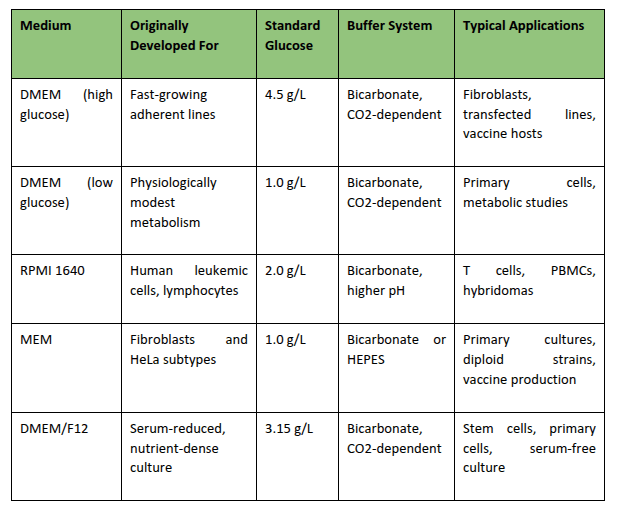
DMEM media comes in two standard glucose formulations: one is low glucose at 1.0 g/L, or roughly blood sugar levels, and the other is high glucose at 4.5 g/L, which works well with fast-growing lines that burn through nutrients quickly.
On its own, DMEM contains no protein, lipids, or growth factors, so labs supplement it with fetal bovine serum (typically 10%) and keep cultures in a 5-10% CO2 incubator to maintain a steady pH. DMEM media supports fibroblasts, transfected cell lines, and vaccine production hosts.
Each of these four media was built for a different cell type, and those design choices still guide how we use them in the lab today.
RPMI 1640 was first developed in 1966 by Moore and his co-workers at Roswell Park Memorial Institute to grow human leukemic cells and lymphocytes in suspension. It is also based on a bicarbonate buffer system, but with a higher standard pH than DMEM, typically around 2 g/L glucose, i.e., lower than high-glucose DMEM.
RPMI 1640 remains the tried-and-tested medium for suspension cultures, including T cells, B cells, PBMCs, and most hybridomas. DMEM media tends to work better for adherent epithelial and fibroblast-like lines. Some labs also run both side by side, as co-cultures work better.
MEM, or Eagle's Minimum Essential Medium, is the simpler formulation Harry Eagle published in 1959 and the one from which DMEM was later built. It contains only essential amino acids at lower concentrations, along with Earle's or Hank's salts, and lacks the extra vitamins and non-essential amino acids that DMEM adds.
That simplicity helps some primary cell cultures and diploid cell strains, which are sensitive to the concentrated nutrient load in DMEM media. MEM is also the base ATCC recommends for HeLa cells and has been used in vaccine production lines. DMEM generally supports faster growth and higher density, while MEM supports slower-growing, nutrient-sensitive cultures.
DMEM/F12 is a mixture (ratio of 1:1) of DMEM and Ham’s F12 medium. F12 component adds trace elements, extra amino acids and vitamins, which allows using lower serum concentration, which many cell types require to grow well.
Researchers reach for DMEM/F12 when they want a nutrient-rich, low serum base for stem cell and primary cell work. Standard DMEM media is a better fit for simpler, well-documented formulations with a long track record, such as those used with most immortalized cell lines.

Most labs grow HeLa cells in DMEM media with 10% FBS. Still, ATCC recommends EMEM for the original CCL-2 line, since HeLa was one of the lines from which Harry Eagle formulated his original media. Either media will be fine, though, so look at the documentation from your specific sub-line first.
DMEM/F12 (1:1) is used as a base for most embryonic and induced pluripotent stem cell protocols, typically supplemented with knockout serum replacement or defined, low-serum supplements. The trace elements and extra amino acids in the F12 component help meet the increased nutrient demands of undifferentiated cultures.
Primary cultures vary by tissue of origin. Some primary fibroblasts do well in regular DMEM media, but especially slower-growing or more delicate populations do better in MEM or a low-glucose DMEM formulation.
The media you use can also affect downstream assays. Serum and phenol red in conditioned media can add background to some cytokine immunoassays, so many labs switch to a serum-free, phenol red-free formulation before collecting supernatant for an ELISA.
If you’re looking for the right products to work with, our proteins and cytokines range at XL Biotec includes kits optimized for the most common basal media.
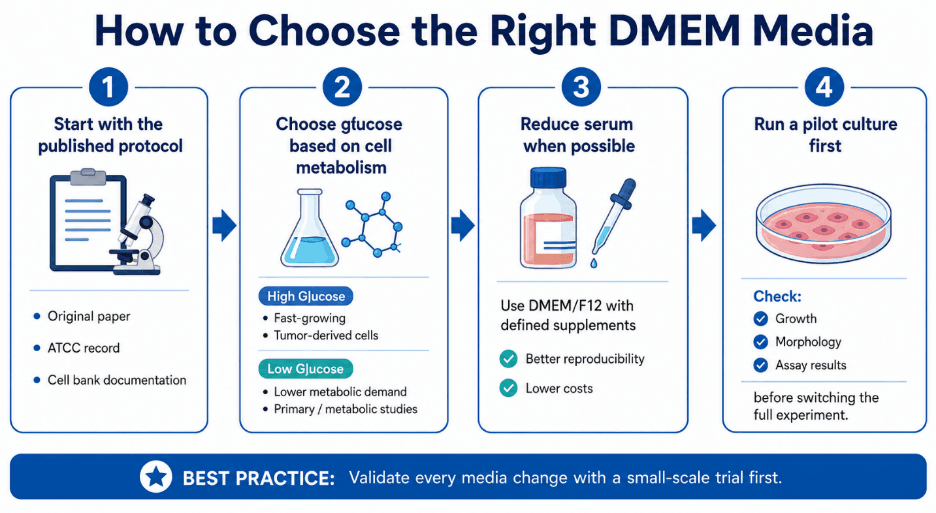
DMEM, RPMI 1640, MEM, and DMEM/F12 were each designed for different cell types. And the original reasons why one works better than another will still be true for yours. So, start with whatever the published protocol or cell bank record specifies, optimize glucose and serum concentrations for your particular cells, and at least run a small trial before scaling up.
XL Biotec has DMEM, RPMI 1640, MEM, and DMEM/F12 formulations in stock — plus the antibodies and cytokine assays that many researchers use with these media.
Shop our full Tissue Culture range, or request a quote to ensure you have the right medium going into your lab! You can also browse XL Biotec’s product catalog for linked reagents.
1. What’s the difference between DMEM and RPMI 1640?
DMEM media has a higher glucose ceiling, up to 4.5 g/L vs ~2 g/L in standard RPMI 1640, and more concentrated vitamins, which is good for adherent cells. RPMI 1640 was designed for lymphocytes and buffers at a higher starting pH.
2. Can I use DMEM for suspension cells like T cells or PBMCs?
Yes, you can, but RPMI 1640 is still the standard choice. It was formulated specifically for the cultivation of lymphocytes and leukemic peripheral blood cells in suspension, and most published protocols using T cells or PBMCs will use RPMI 1640 rather than DMEM.
3. What is DMEM/F-12 and when should I use it instead of DMEM?
DMEM/F12 is a 1:1 mix of DMEM and Ham's F12 that also adds trace elements and extra amino acids. It’s most used whenever a protocol calls for a nutrient-dense, low-serum base, which is pretty much all stem cell work and most primary cells.
4. Which DMEM formulation, high glucose vs low glucose, should I use for metabolic studies?
Low-glucose DMEM is 1.0 g/L and closer to normal blood glucose and suits normoglycemic modeling. High-glucose DMEM (4.5 g/L) is used when you want to create hyperglycemic conditions or work with rapidly dividing, metabolically active cell lines.
5. What medium should I use for HeLa cells?
ATCC officially recommends that you use EMEM with 10% FBS for CCL-2 HeLa, but most people also culture HeLa in DMEM. Look at the documentation for your specific sub-line first, though.
6. Can I switch my cell line from RPMI 1640 to DMEM?
Some lines do work in both over a few passages, but any change should be evaluated with a small-scale trial and tested for its impact on growth rate, morphology, and assay readouts, because not every line will tolerate such changes to the basal formulation.
7. Does the choice of medium affect ELISA or cytokine assay results?
Yes. In some cytokine immunoassays, phenol red and serum proteins carried over in conditioned media can add background, so many labs collect supernatant from a serum-free or phenol red-free culture before they run an ELISA.
8. Can I mix DMEM and RPMI 1640 for co-culture experiments?
Yes, that is a commonly used approach for co-cultures where you’re co-culturing adherent stromal or epithelial cells with suspension immune cells. But the mixing ratio must be validated, typically starting at 1:1 for both cell types, before you can run the full experiment.
