Your list is empty
Add products to request a quote

Key Takeaways:
HepG2 and Huh7 are both immortalized human hepatocellular carcinomas (liver cell cancer lines) widely used in vitro to monitor the behavior and progression of carcinogenic tissues. Both cells have proven remarkable at advancing biomedical experiments, enabling researchers to evaluate the liver’s resilience against potentially malignant agents.
Scientists also rely on HepG2 and Huh7 cell lines to facilitate general research into normal hepatic physiology. Findings from these experiments enable researchers to develop more robust drugs and vaccines, potentially reducing the global liver disease burden.
However, that’s probably where the similarities end. HepG2 and Huh7 differ in many other ways. Understanding differences between these cell lines is critical in adapting the right option for each biomedical research project.
In this post, we compare HepG2 vs. Huh7 to help you choose either cell line for your upcoming experiment.
Table of Contents:
HepG2 is an abbreviation for Hepatocellular carcinoma - Group 2, a class of immortal cell line obtained from human liver tissues.
HepG2 displays non-tumorigenic properties in nude mice. Besides, this cell line possesses wild-type p53 genes that allow it to be explored extensively in microbiology studies.
Huh7 stands for Human hepatocellular carcinoma - Clone 7.
Huh7 cells notably possess mutant p53 genes and are widely deployed in viral hepatic research programs.
Before we uncover the differences between HepG2 and Huh7 cell lines, we must reiterate that both derive from human liver cancer tissues. The cells were isolated from individuals, primarily to help monitor the behavior and progression of malignancies.
Another notable similarity between HepG2 and Huh7 is that they both thrive as epithelial-like adherent cells when subjected to standard 2D monolayer cultures.
Besides, HepG2 and Huh7 generally respond in the same way when exposed to exogenous lipids.
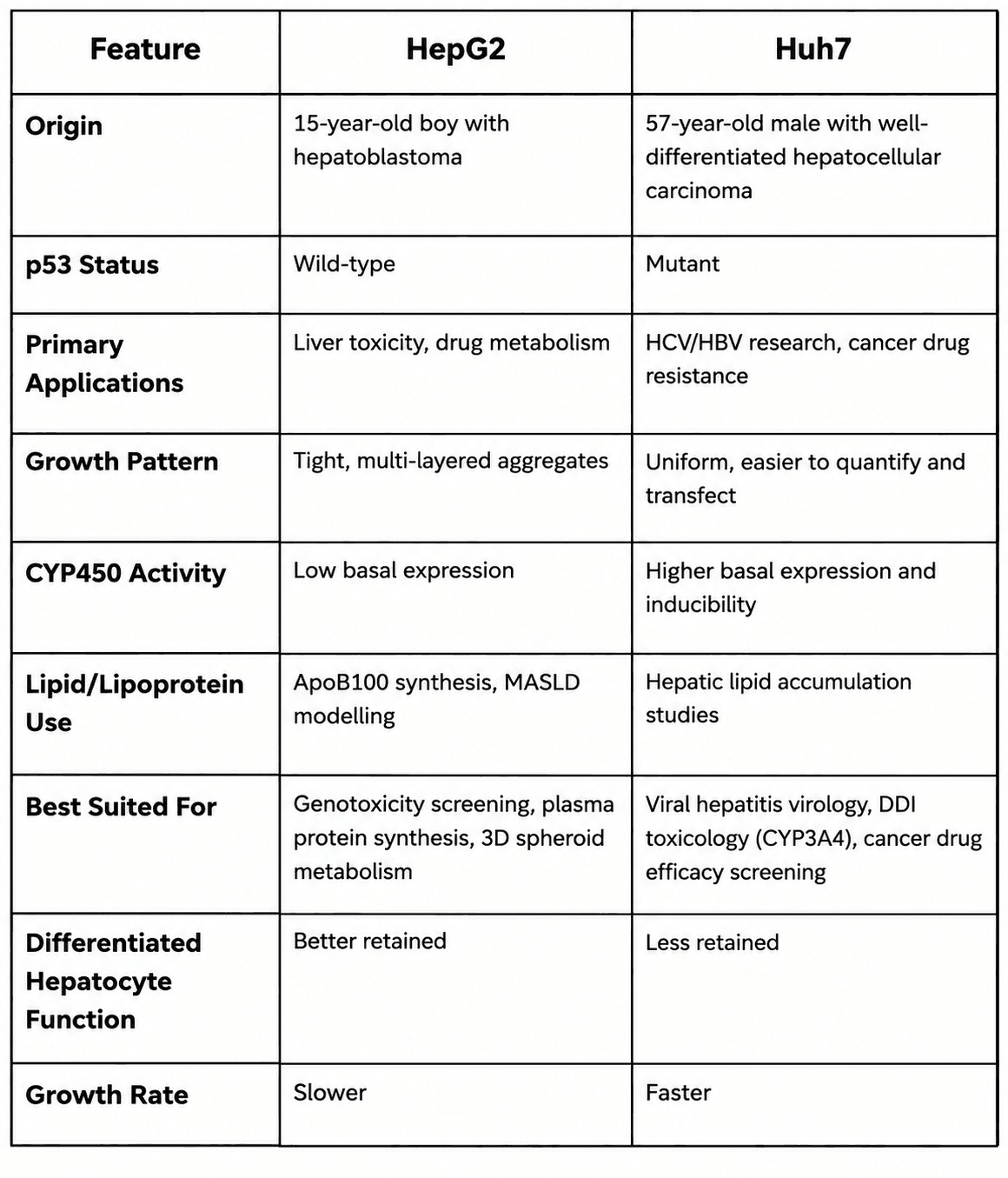
A comparison table fits best right after the "What's The Difference Between HepG2 and Huh7 Cells?" section (before the "Which Is Better" summary) — it gives readers a quick-reference recap of the seven points you just walked through in prose. Here's the table:
HepG2 was isolated from a 15-year-old boy with hepatoblastoma, a severe form of liver cancer.
Meanwhile, Huh7 came from a 57-year-old male with a well-differentiated hepatocellular carcinoma.
HepG2 retains a wild-type TP53 gene, making it the standard model for studying genotoxicity and DNA damage along pathways that rely on P53.
Huh7 displays a mutated P53 gene. Therefore, it’s better suited for tracking the progression of adult hepatocellular carcinoma that exhibits P53 mutations.
In one study, researchers found that Huh7 was more reliable than HepG2 in studying cytotoxicity associated with the mutant P53.
One of the most significant Huh7 vs. HepG2 comparisons pertains to their typical usage.
Many researchers consider HepG2 ideal for analyzing liver toxicity and drug metabolism, Huh7 is the premier model for studying hepatitis C virus (HCV) and hepatitis B virus (HBV).
Huh7 has also proven reliable in evaluating cancer drug resistance.
Huh7 is the best liver cell line in terms of growth and replication. These cells spread more uniformly across culture plates, making them easier to quantify and transfect.
HepG2 generally grows into tight, polarizing multi-layered aggregates that often require diligent trypsinization to analyze.
Which liver cell line to use for drug metabolism between HepG2 and Huh7?
Both HepG2 and Huh7 demonstrate low basal Cytochrome P450 enzyme activity compared to primary hepatocytes. However, Huh7 generally displays superior basal expression and CYP450 inducibility.
If you’re working with HepG2, you may require alternative culture formats like 3D spheroidal configurations to account for the drug metabolic inefficiency.
Researchers generally utilize HepG2 to conduct human apolipoprotein-B100 (ApoB100) synthesis and secretion experiments.
Previous studies have found HepG2 to be a quite reliable model for investigating metabolic dysfunction-associated steatotic liver disease, thanks to its ability to readily interact with free fatty acids.
HepG2 is typically best for;
Meanwhile, Huh7 would be ideal for;

HepG2 and Huh7 are both critical cell lines used in investigating hepatocellular carcinomas. Neither is universally better, and the choice largely depends on your upcoming experiment.
Select HepG2 if you’re planning a baseline metabolic or toxicological study. Meanwhile, Huh7 cells would be preferable for experiments involving viral replication or transfections.
Since 2009, XL Biotec has positioned itself as a leading supplier of biomedical and molecular research products. We offer reliable HepG2 and Huh7 cell lines, subjecting each sample to extensive screening to minimize microbial contamination. Our product catalog also includes industry-validated ELISA kits, alongside several reagents.
Contact us today to order HepG2 or Huh7 cell lines and enrich your next biomedical research experiment.
HepG2 and Huh7 differ fundamentally in their origin. HepG2 comes from a hepatoblastoma, whereas Huh7 derives from a well-differentiated hepatocellular carcinoma.
Researchers generally utilize HepG2 for drug metabolism studies. However, both HepG2 and Huh7 cell lines have lower baseline responses than the primary liver cells.
When it comes to Cytochrome P450 enzyme expression, there’s really no clear winner between HepG2 and Huh7. Both exhibit very low basal CYP450 levels compared to primary hepatocytes.
Huh7 is generally preferable for viral hepatitis research, with many researchers utilizing specific sublines like Huh-7.5.
Both HepG2 and Huh7 typically require standard DMEM containing 10% FBS and pen-strep.
While HepG2 and Huh7 can thrive in the same media, they exhibit different growth rates.
Huh7 tends to grow and replicate much faster.
Yes. HepG2 and Huh7 cell lines may be used for steatosis because they both respond remarkably well to free fatty acids.
HepG2 retains differentiated hepatocyte function better than Huh7.
In terms of genetic variances, HepG2 appears as a near-triploid with wild-type P53. Huh7 is a hypertriploid with specific point mutations in the P53 gene.
HepG2 offers higher throughput screening for baseline hepatotoxicity compared to Huh7.
